The Welsh language has been described as a national treasure that belongs to us all. We are proud to be recognised as a funder that provides a bilingual service for people living in Wales. Through our funding, we enable communities to support the use of Cymraeg in everyday life.
The Welsh language is officially recognised in Wales, and the Welsh Government has set a target to increase the number of Welsh speakers to a million by 2050. As a statutory body, The National Lottery Community Fund (the Fund) in Wales fully supports this target.
From the initial contact with us you will be provided with a bilingual service and, should you wish, your project can be managed by a Welsh speaking Funding Officer.
Our bilingual offer:
- We are a bilingual employer
Here at The National Lottery Community Fund in Wales, we ensure our recruitment process is bilingual to attract a bilingual workforce. We recognise the importance of people being able to use their Welsh language skills daily. We also encourage colleagues to use their Cymraeg within the workplace and provide support to colleagues who want to develop or improve their Welsh language skills.
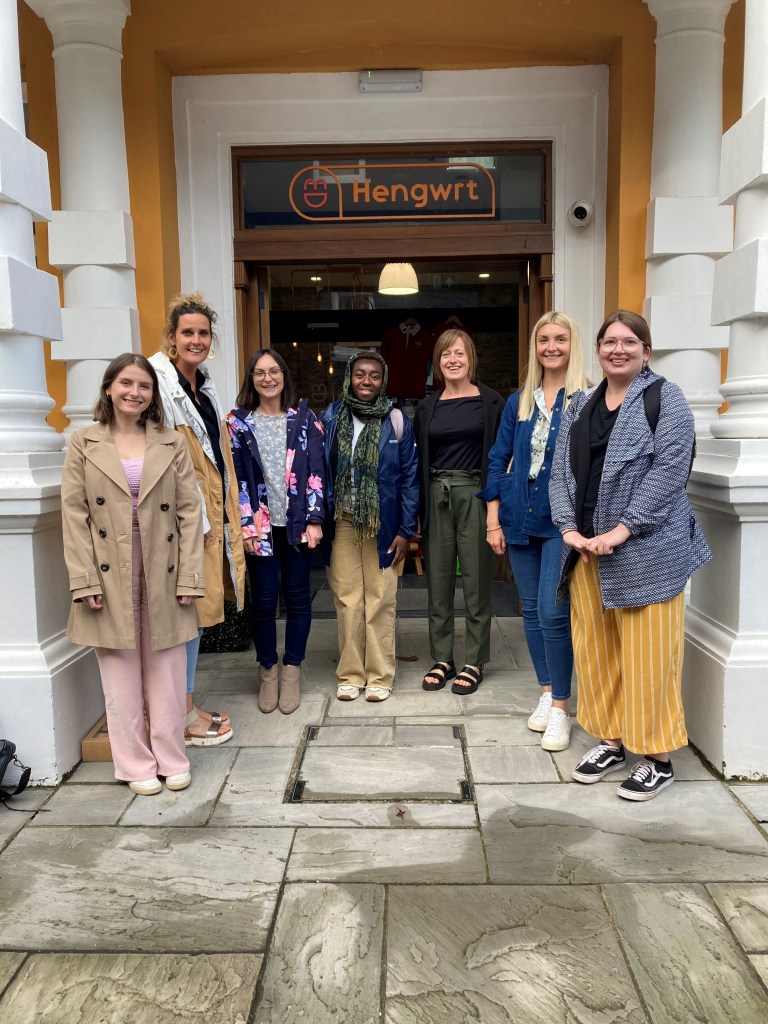
Members of our Communications Team at a project visit to Hengwrt, Llandeilo
We are pleased to be able to provide a positive and supportive environment for Welsh language speakers and learners. Over 55% of our workforce in Wales are Welsh speakers or learners.
- We provide a bilingual service
We carefully consider the language needs of vacancies when recruiting at the Fund. As the Welsh Language Commissioner’s recent assurance report highlights, recruiting a bilingual workforce enables service requirements to be met bilingually.
We are pleased that when customers seek funding advice or apply for funds we are able to provide a fully bilingual service. Our Welsh speaking employees give advice and assess Welsh language funding applications.
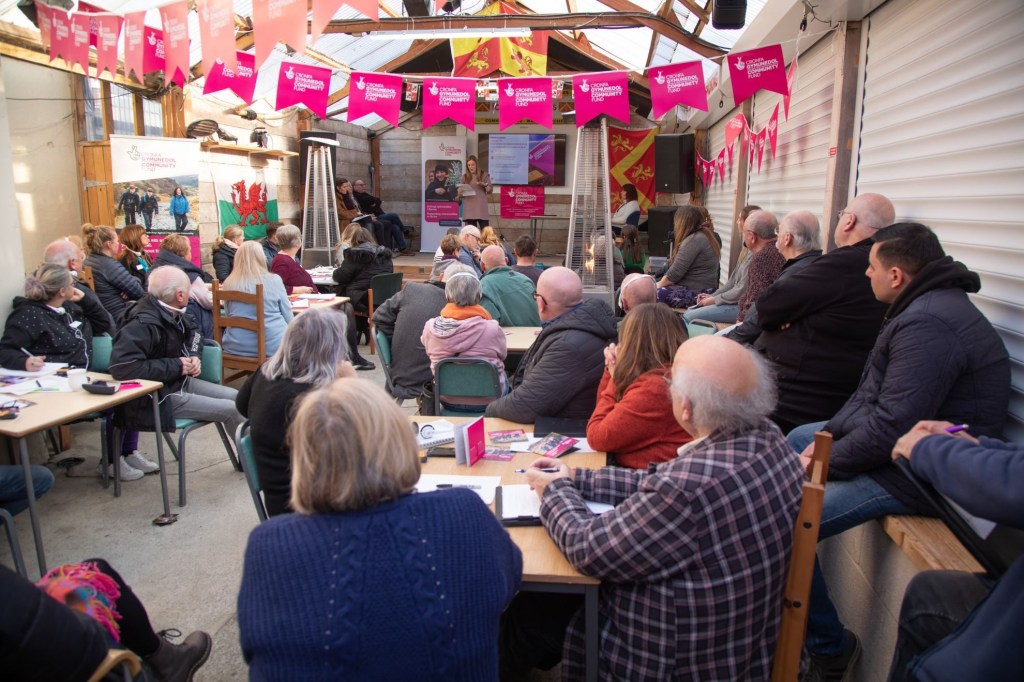
A funding event at the Iorwerth Arms, Bryngwran
- We promote the Welsh language
We have recently acted on two fronts to promote the use of the Welsh language in the projects we fund.
Internally, we have developed new guidance for colleagues to highlight what our expectations are of our grant holders in relation to our Welsh language standards. This encourages the Welsh language to be considered when applications are assessed.
Externally, we have also published a ‘Planning a Bilingual Project Guide’ for grant holders. This supportive guide encourages grant holders to consider the language requirements of the communities they serve; to produce a Bilingual Project Guide/Plan outlining how their projects will be bilingual. It also aids them to consider what resources and support they will require to achieve this. This guidance is intended to ensure the Welsh language is considered throughout the application process, as well as into the delivery of the projects.
In addition, we encourage projects with a strong Bilingual Project Plan or Policy to apply for the Welsh Language Commissioner’s ‘Cynnig Cymraeg’, to work towards being officially recognised as a bilingual service.

A Farmers Club event held by Tir Dewi in Anglesey
Encouraging our grant holders to deliver their projects bilingually creates more opportunities for communities across Wales to use or develop their Welsh language skills.
In Wales we are continually considering how we provide our Welsh language offer as an employer and funder. As part of this process, we take an interest in externally published reports from the Welsh Language Commissioner and data sets such as the 2021 Census.
Our examination of data
In June 2023, the Wales Committee at The National Lottery Community Fund examined the 2021 Census results, with an interest in understanding the health and progress of the Welsh language. Three key points were derived from the results:
- There was an overall decrease in the number of recorded Welsh speakers, as well as a decrease in the recorded proportion of the population able to speak Welsh.
- There was a recorded decrease in the percentage of Welsh speakers from what could be considered the traditional heartlands of the Welsh language. We considered Ynys Môn, Gwynedd, Ceredigion and Carmarthenshire as traditional heartlands of the Welsh language (they have traditionally had the highest proportion of Welsh speakers).
- There was a recorded decrease in young people aged between 3 and 15 years old able to speak Welsh.
The apparent downward trend in Welsh speakers was disappointing to see and consequently we explored the potential factors that could be contributing towards this decline. Covid-19, the ability of people to retain their Welsh language skills overtime, demographic changes such as positive net migration and the potential of Welsh speakers migrating outside of Wales, as well as the economy were some of the factors we considered.
More recently we have also taken note of the Welsh Language Commissioner’s assurance report ‘Raising the Bar’, which highlights a need to address oral services through the medium of Welsh. It states that “18% of the sample surveyed responded that they had experienced someone preventing them from speaking Welsh” (p.3). Disappointingly this rises further to 29% when considering respondents between 16 and 34 years of age.
Acknowledging these reports, The National Lottery Community Fund in Wales recognise the importance of:
- People being able to use Welsh as their first language throughout Wales.
- People being provided positive experiences to speak and learn Welsh.
- The pertinence of both these issues for young people in particular.
In response, the Fund in Wales has considered how our services and funding can impact and improve the Welsh language. Here are some of the practices we have adopted for some time, as well as some new actions being taken.
Case studies
We awarded Mudiad Meithrin’s funding application of £496,945 to develop a new, safe, educational, and diverse YouTube channel to encourage families to introduce and use the Welsh language at home, promoting it as a language beyond the world of care and education throughout Wales.
We have also funded Menter Gorllewin Sir Gâr Cyf with a £477,147 grant to support the Welsh language in the community over five years. It offers work placement opportunities for young people across north Carmarthenshire and south Ceredigion areas, including 14-18 year olds. They work across sectors to organise volunteering opportunities to raise aspirations and confidence, developing skills to increase employability, aiming to increase Welsh in the workplace and highlight the benefits as an essential skill.

The cast of young people at Cwmni Theatr Eleth
Cwmni Theatr Eleth on Anglesey received £10,000 of funding and put on a Welsh language production of the show Joseph with a cast of local, young people. The activity supported the health and wellbeing of the young people and increased their confidence following the ongoing effects of the Covid-19 pandemic.

Local school pupils performing at Merthyr Tydfil CBC Shwmae Sumae event at Cyfartha Park
To coincide with Diwrnod Shw’mae Su’mae, Merthyr Tydfil County Borough Council held an event in Cyfarthfa Park with local school children taking part by singing Welsh songs along with other various entertainment through the medium of Welsh. The grant of £10,000 will also go towards other cultural events throughout the year, such as a Christmas fair, to provide their local community with an opportunity to enhance their knowledge and understanding of the Welsh language.
*
The continuation and promotion of these actions demonstrate that in Wales, The National Lottery Community Fund is fully committed to not only addressing the decrease in the Welsh language, but also in supporting the Welsh Government’s target to increase the number of Welsh speakers to a million by 2050.
Our new strategy ‘It Starts with Community’ has four community-led missions in total:
- Supporting communities to come together.
- Supporting communities to be environmentally sustainable.
- Supporting communities to help children and young people thrive.
- Supporting communities to enable people to live healthier lives.
The Welsh language is a treasure, but it is first and foremost a community language that can bring people together.
 The National Lottery Community Fund Blog